
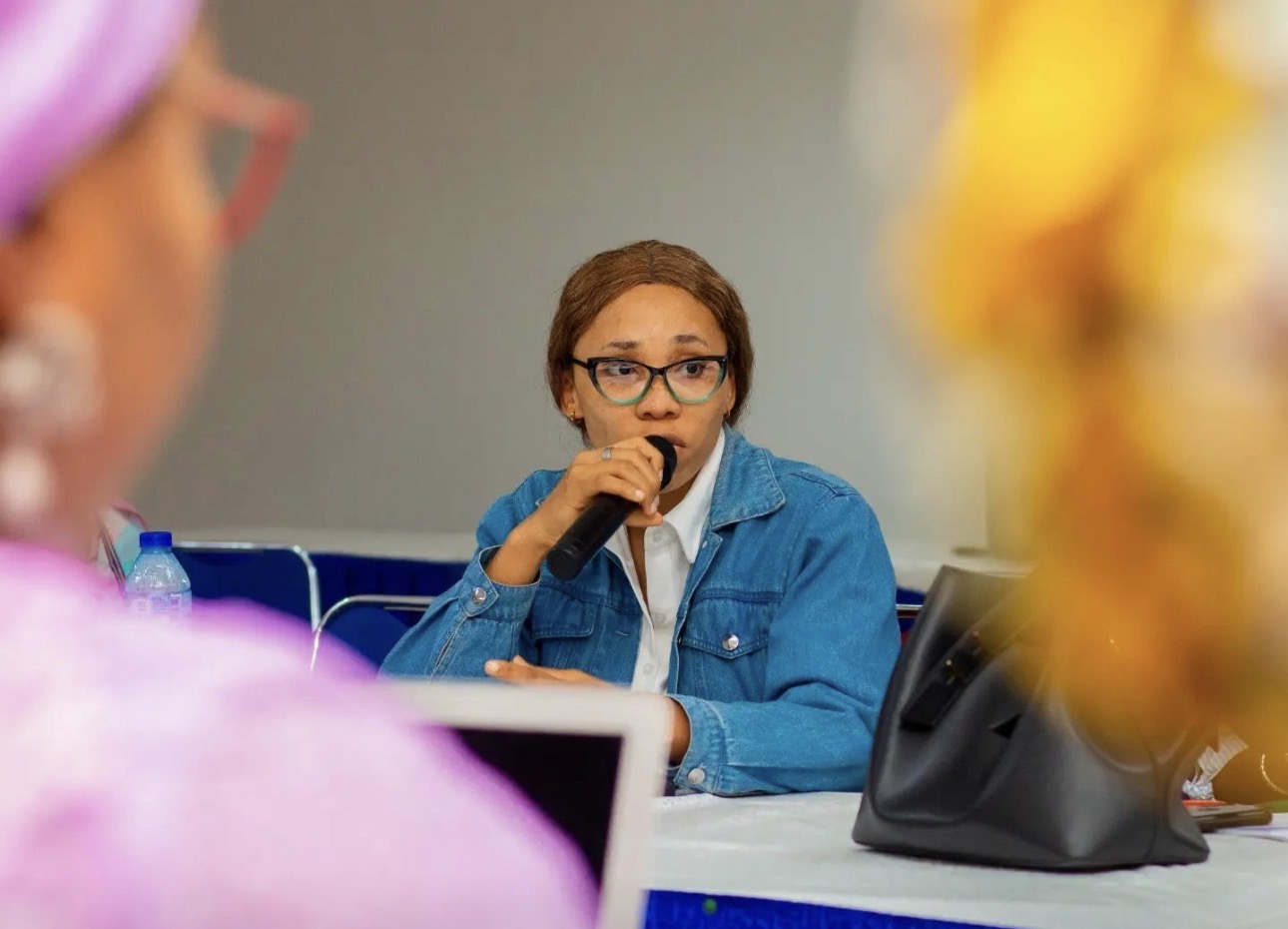
The first thing Nympha Nzeribe Ozougwu remembers about herself is that she was always writing. Long before she founded a women’s network or earned a graduate degree in London, she was a child in Nigeria filling pages with stories. “As a child, I wrote. I was an avid reader,” she said. “I’ve always had an interest to tell stories.”
It is a simple memory, but it explains much of what came after. Reading led to writing, and writing became a way of observing people and the worlds they carried. Years later, that early habit would shape a career that now spans communications, cultural organising, and women’s development work across several African countries.
Today, Ozougwu is a communications professional and the founder of Lady Dynamique Network, a women‑led organisation she established in 2022. The group supports creative work, advocacy, and community projects, and has grown into a network of more than 500 women. She recently completed an MA in Media and Communication Industries at the University of East London, a degree that aligns closely with the work she has been building for years.
She describes her professional life in three parts: “Communication, development and partnerships.” Those areas, she said, “show up in everything I do,” and they now form the backbone of Lady Dynamique Network’s programmes.
Ozougwu grew up in Nigeria, where books were her earliest companions. She wrote stories throughout her childhood and continued into adulthood. The practice sharpened her attention to detail and deepened her interest in people’s lived experiences. When she eventually began working in communications and organising events, the transition felt natural. She was still telling stories—only now they were tied to real communities and real needs.
Her latest project, a poetry anthology featuring more than 50 submissions from women across Africa, is an extension of that early instinct. The anthology, titled Lady Dynamique, is expected later this year. It is part of the organisation’s broader effort to create platforms where women can express themselves creatively and be taken seriously as contributors to cultural life.
“I like to call myself a cultural architect,” she said with a laugh. “Because there’s just a lot of things around me… a lot of you know.” The phrase is her way of acknowledging that her work does not fit neatly into one category. Communications, development, partnerships—she treats them as interconnected tools rather than separate professions.
From the beginning, she wanted Lady Dynamique Network to do more than collect stories. “I didn’t want it to be like, okay, you’re just writing stories,” she said. “What comes after the stories? How are you impacting the people that you’ve told their stories?”
Those questions became the organisation’s compass. The goal was not only to document women’s experiences but to create opportunities around them.
One of the earliest examples was the Creative Exchange Program (CEP), a 12‑day initiative that brought together women from eight African countries. The programme covered design thinking, creative entrepreneurship, and digital storytelling. It included virtual sessions and a daily journal‑style workbook that Ozougwu designed herself. Participants used it to reflect, complete assignments, and develop their stories.
The programme also offered a $100 digital‑story prize. The amount was small, but the effect was significant. Women shared stories of resilience, loss, and survival. Some asked to remain anonymous. Others spoke openly about experiences they had never voiced publicly. “We’re not looking at stories of people who are already there,” she said. “We want to give the average woman a voice.”
As the programmes expanded, so did the community. Lady Dynamique Network now includes more than 500 women who share resources, collaborate on projects, and support one another’s work. Membership is free, and most activities are funded internally or through small grants.
In 2023, the organisation moved into environmental work. With support from the African Human Rights Foundation, Ozougwu led a waste‑management project in Borno State in north‑eastern Nigeria. The region has limited recycling infrastructure, so the team trained women in waste sorting and connected them with collectors and recycling companies outside the area.
“There are no recycling plants there,” she said. “So we connected them with people who could collect their waste.”
The project combined environmental education with income‑generating opportunities and was later documented in a report shared with partners.
Ozougwu often returns to a belief that guides much of her work: progress spreads through connection. “If we hold one woman, the other woman can hold the other woman,” she said. It is a simple idea, but it shapes how she designs programmes and how she thinks about community.
She frequently cites Access Bank’s W Collective in Nigeria as an example of what institutional support for women can look like. “I’m very proud of how they built that community,” she said. She is studying how such structures emerge and how organisations can transition from corporate spaces into development work.
Her own path has not followed a straight line. She has moved between writing, corporate communication, organising, and academic study. The master’s programme in London strengthened her understanding of media industries and sharpened her research and project‑management skills. But it did not shift her priorities.
“If I’m going to tell a woman’s story,” she said, “there is something around it that is going to either change this person’s life.”
Lady Dynamique Network is preparing to release its poetry anthology later this year. More programmes are planned, and Ozougwu is seeking partnerships and funding to expand the organisation’s reach. The goal is not scale for its own sake, but access—more women, more stories, more opportunities.
She is still the child who wrote stories, but the stories now belong to many women, not just one. And the structures she is building—small, steady, and deliberate—are designed to last.
Second Eye Africa